Ask this in public and you get numbers back. Three hundred years. Five hundred. The 1600s if the records are kind, 1500 if you are lucky, and someone will always bring up Charlemagne. One of the threads Google has ranked near the top of this question for years was started by a person who had just loaded their details into FamilySearch and come out with a line reaching back to 190 BC. Underneath, other researchers explain as kindly as they can that this is not what it looks like.
All of those answers are honest and none of them are about you.
Every number you will read is somebody else's tree.
Google's own summary answers the question with a range: most people working from paper records get back three to five hundred years. That is true the way "most adults are about five foot seven" is true. It describes a spread and tells you nothing about the line in front of you. The page below it is a Facebook thread, a fourteen-year-old Quora answer, a 2014 post about how long tree building takes, a Mumsnet thread whose first poster reaches 1450 on her mother's line, 1700 on her husband's and pre-1066 on her father's, and a piece by a professional genealogist whose title asks people to stop asking this question altogether.
Nobody there is wrong. They are each answering with their own tree, which is the one tree that cannot help you. Look again at that Mumsnet poster, though: three lines in one family, three different stopping points, six hundred years apart. She is not giving one answer because she does not have one. Neither do you.
Your wall is a record series that stopped, and it has a date.
Lines do not fade out gently as the past gets mistier. They stop, usually hard, at the point where the records you have been leaning on begin. Below that date there is either a different kind of record or nothing. Which date it is depends on the country, often on the county, and sometimes on where your ancestors stood in that society. That makes it something you can look up in ten minutes instead of discovering over a year.
In the United States the floor is 1850, and for millions of families it is 1870.
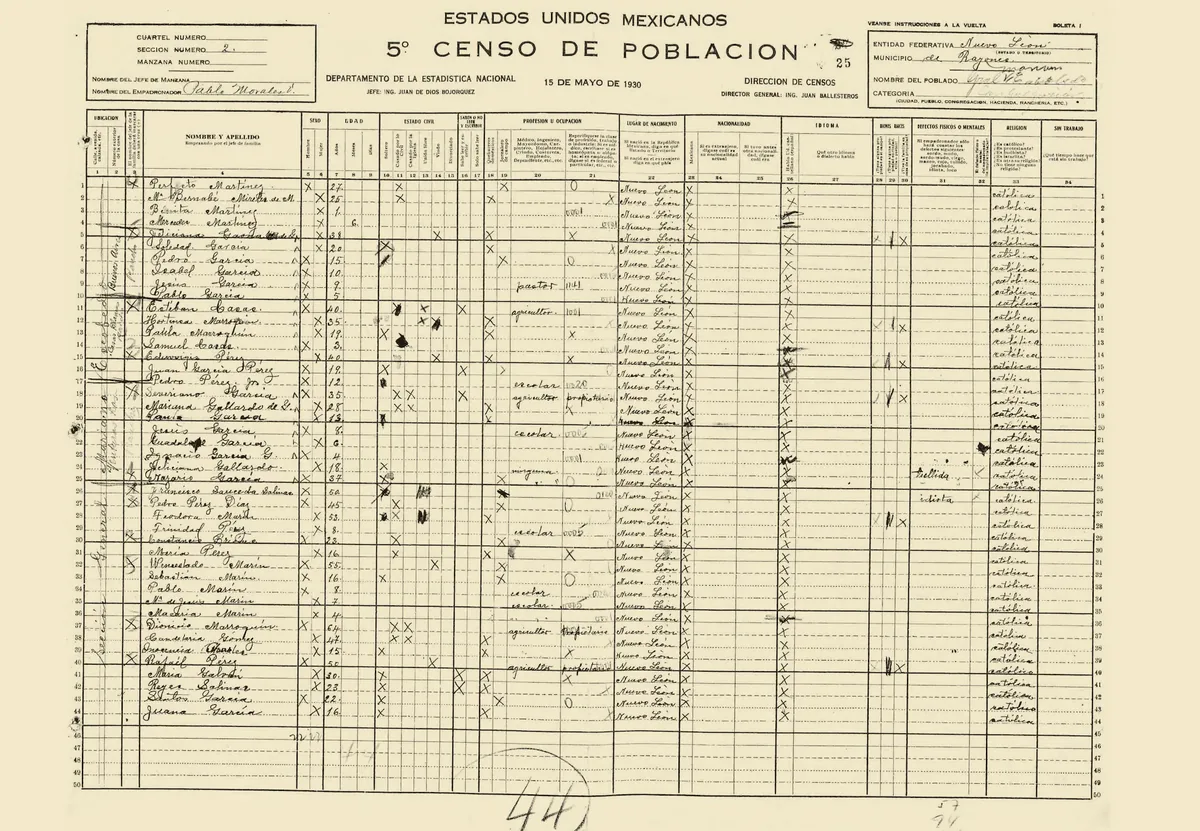
Before 1850 the federal census names the head of the household and reduces everyone else to tick marks in age and sex columns. From 1850, Schedule 1, Free Inhabitants, records every free person by name. That one change is why so many American trees are crowded back to 1850 and thin above it.
The word carrying the weight in that sentence is "free". The 1850 census had a second form. Schedule 2, Slave Inhabitants, has fields for the name of the slave owner, the number of slaves, then age, sex and colour. There is no field on the form for the enslaved person's own name. The 1860 schedule works the same way. So for millions of American families the federal census does not name their ancestors until 1870, the first one taken after emancipation, and researchers have a name for that edge: the 1870 brick wall. Crossing it means identifying the last enslaver and then reading his paperwork, because that is where the names were written down, in probate inventories, bills of sale and wills. It is harder, slower work, and it is a different question from the one this article is about.
In England and Wales two dates do nearly all the work.
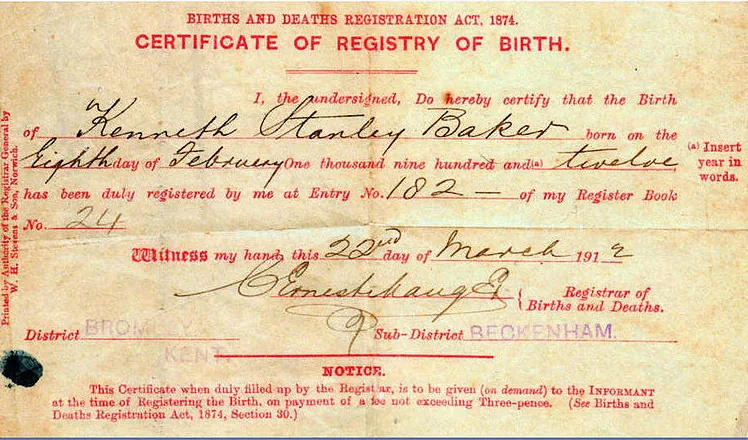
Civil registration of births, marriages and deaths began on 1 July 1837, and every England and Wales certificate dates from then. That is your first floor. Below it you are in parish registers, which The National Archives dates plainly: before 1538, when parish registers began, these events were not officially recorded at all, though a priest may have kept notes.
So a typical English line runs smoothly to 1837 on certificates, continues more raggedly through baptisms, marriages and burials, and stops somewhere short of 1538 depending on whether that parish's books survived and whether anyone has transcribed them. Two things worth carrying with you. Parish registers record baptism and burial, which are not the same events as birth and death. And survival is local, so one lost register leaves a hole that no national index can fill.
In Ireland the wall is a single afternoon.
The Public Record Office of Ireland opened in 1867 and gathered centuries of records into one building beside the Four Courts in Dublin. Its Deputy Keeper, Samuel Ferguson, reported proudly on the fireproofing, writing that he hoped there would be "nothing inflammable within the building ... except the records themselves; and these, I may observe, would be extremely difficult of combustion".
On the afternoon of 30 June 1922, during the bombardment of the Four Courts, an explosion in the block opposite set the Record Treasury alight and it burned. Nineteenth-century census returns, wills, and the diocesan and parish registers of the Church of Ireland went with it. Charred fragments came down across Dublin and as far as Howth. That is why an Irish line so often stops dead in the nineteenth century while an English one of the same family keeps going. The Virtual Record Treasury has spent years rebuilding what it can from copies held elsewhere, and it is the first place to look before concluding an Irish record is gone.
A line that reaches 190 BC was copied, and copied lines have tells.
Shared trees splice. Someone attaches a plausible parent, ten thousand people copy it, and within a few years the join looks like consensus. Two tells catch most of them. The first is a generation that arrives carrying no source at all, sitting above generations that each have three. The second is a one-step leap in status, where a farm labourer's father turns out to be a baron. Real social climbing happens across generations and leaves paperwork behind it. Where a line crosses into a documented noble or royal pedigree, genealogists call the join a gateway ancestor, and the join itself is exactly the link that needs a record rather than a consensus.
If you have inherited a tree like this, our guide to sources you can trust covers how to test a join before you build another twenty people on top of it.
Far enough back, your tree stops being a tree.
The arithmetic is unforgiving. Every generation doubles your ancestor slots, so ten generations asks for 1,024 people and thirty generations asks for more than a billion, which is comfortably more than the world held at the time. The slots do not go unfilled. They get shared, because your ancestors were related to each other. Genealogists call it pedigree collapse, and it means the deep end of any pedigree is a net rather than a branching tree. It is another reason a chart claiming an unbroken single line into antiquity is telling you about its compiler rather than about the past.
Find your floors first, then spend your year on the line with headroom.
The practical version takes an afternoon. Write out your eight great-grandparents and, for each, note the country and the county or state the line sat in. Look up when that place started keeping the record type you need, and remember that the relevant unit is often smaller than the country: a US county that did not exist yet kept no deeds, and a parish that burned kept nothing that survived. You will usually find two or three lines still have decades of headroom while the rest are already sitting on their floor. That tells you where the next year of research should go, which is the question underneath the one people actually ask.
When a line really is at its floor, the work changes rather than ending. Our guides to genealogy brick walls and destroyed records cover the substitutes, and when the trail goes cold is about knowing which of the two situations you are in.
The honest answer to how far back you can go is that you have eight answers, not one, and every one of them is a date you can look up today.