Why do married women disappear from the records?
Under coverture, a married woman's legal identity merged into her husband's, so she rarely appears alone in a deed, a lawsuit, or a tax list. American states dismantled coverture piecemeal between roughly 1839 and 1887. Newspapers, church notices, and gravestones called her Mrs. John Smith, with her own surname nowhere on the page.
An unmarried woman was a feme sole and could act for herself. A married woman was a feme covert and mostly could not, so the documents that would otherwise name her simply do not exist. She surfaces in a handful of situations: releasing her dower interest when her husband sold land, being widowed, or being named in a relative's will. Clerks even had shorthand for her presence without her name, which is why deeds say et ux (and wife) and wills call a widow a relict.
So the search is not for records about her. It is for records about other people that had to name her.
Which marriage records name the bride's family?
Look for every document the marriage produced: the licence application, the bond, the minister's return, the register entry, and a parent's consent when either party was under age. The bondsman or witness is often the bride's father, brother, or uncle, which is how a maiden name survives even when the register entry is thin.
- The licence application is usually the fullest of the set, and it often names both fathers.
- A marriage bond was a financial guarantee, signed by a man with a stake in the bride: most often her father or her brother.
- The minister's return was filed separately from the licence, so it survives in some counties where the licences do not.
- A parent's consent proves an age as well as a name, since it was only needed when one party was a minor.
- Church registers add sponsors, witnesses, and sometimes the bride's parish of origin.
These pieces were filed in different places, which is good news when a courthouse burned. Bonds sometimes survive when registers do not, and published abstracts made before a fire can preserve both, an angle covered in researching around destroyed records.
Do her children's records give her maiden name?
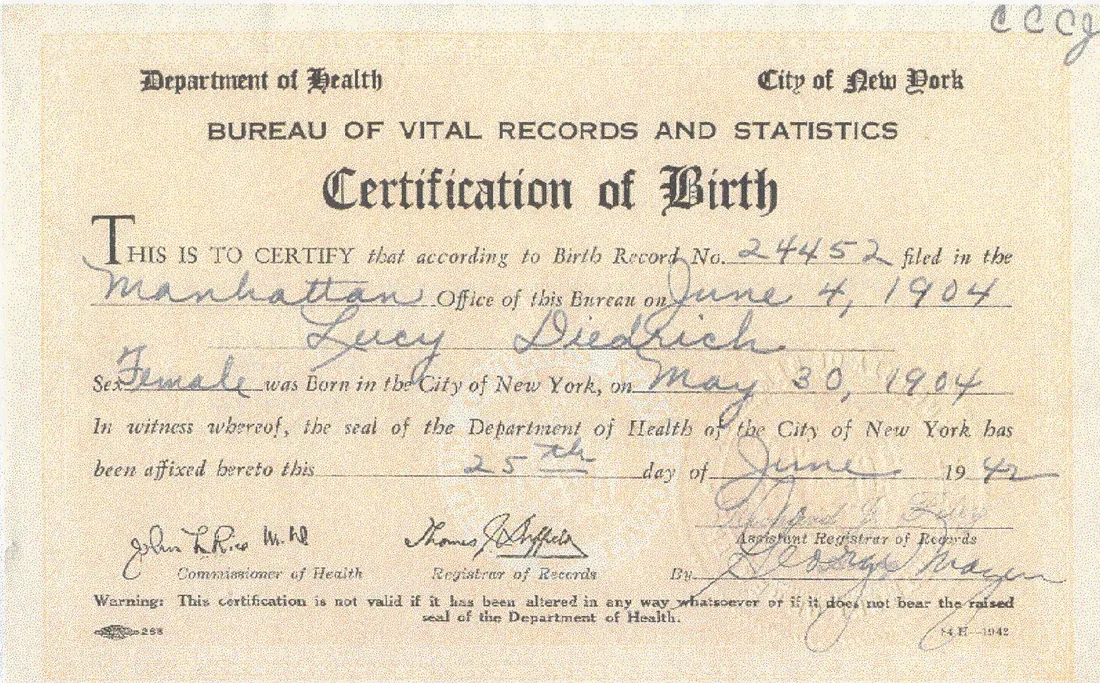
A mother's maiden name is a standing field on modern birth certificates and on many of her children's death certificates, so a child who died in 1955 can name a mother born in 1870. Social Security applications from 1936 onward asked for the father's name and the mother's full maiden name.
Work every child, not only your direct ancestor. Each one generated a birth record, a marriage record, and a death record, and any of them can carry the mother's maiden name. The Social Security applications (form SS-5) and the Numident abstracts drawn from them are held by the National Archives; be aware that records for people born in 1910 or earlier are often abbreviated and may omit the parents entirely.
The pattern to expect is that the answer arrives late. A woman born in the 1860s, married in the 1880s, and dead in 1910 may first be named in a document created in 1962, on the death certificate of her youngest son.
What does her own death record give you?
A death certificate usually asks for the decedent's father's name and mother's maiden name, and it names the informant who answered those questions. Check who that was before you trust the answer: a daughter naming her grandparents is very different evidence from a boarding-house keeper guessing.
Around the certificate sit records nobody thinks to order. An obituary names surviving siblings, which gives you her birth surname even when it never gives her maiden name outright. Funeral-home ledgers often hold what the family said before it was tidied into a form. Cemetery plot records name whoever bought the ground, which is frequently her father or brother, and a plot full of one surname beside her grave is a strong lead.
How do wills and probate files name a married woman?
Estate files identify women through relationships: "my daughter Mary, wife of John Smith". One clause like that proves a maiden name outright. Work the wills of every candidate father in the neighborhood, plus dower releases, guardianship bonds for her minor children, and the distribution lists in her father's estate.
Distribution and partition records are the underused half. When land was divided among heirs, the file lists every heir-at-law, married daughters included, usually with their husbands' names attached. A widow's dower interest (customarily a life interest in a third of the real estate) generates its own paperwork, and so does the remarriage that ended it.
If the wording is the obstacle, our records glossary covers the legal shorthand these files are written in.
Can a naming pattern point to a maiden surname?
A mother's maiden surname often shows up as a son's middle name, and many families followed fixed patterns. The Italian custom named the first son for the paternal grandfather and the first daughter for the paternal grandmother. Use a pattern to decide which records to order. Do not enter it as a fact.
Patterns break in predictable ways: a name reused after a child died young, a godparent honoured out of turn, a family that abandoned the custom on arrival in a new country. And the same custom that gives you a lead creates the other classic wall, because it packs one parish with cousins who share a name. That problem has its own guide: same-name ancestors.
What if no record names her at all?
If no record states her maiden name, build the cluster around her: baptism sponsors, marriage witnesses, the households either side in the census, and the men who posted bonds for her family. A woman with no records of her own is almost always named in someone else's.
| Record | What it gives | Caveat |
|---|---|---|
| Marriage licence, bond, return | Her surname, often her father's name | Three separate filings; check all three, and check the county the bride lived in |
| Children's birth and death records | Mother's maiden name as a standing field | Quality depends on the informant; work every child |
| Her death certificate | Father's name and mother's maiden name | Only as reliable as the informant named on it |
| Her father's will or estate file | Names her as a daughter and names her husband | You need a candidate father first; work the whole neighborhood |
| Church records | Sponsors and witnesses, usually kin | Held locally and often unindexed |
| Social Security application | Father's name, mother's maiden name | Abbreviated for many people born 1910 or earlier |
This is a wide, repetitive search across many record sets, which is what AncestorIQ's Deep Research is built to run: it searches record sets across several archives for the people around her and keeps a citation on every fact it proposes. The general method for a stalled line is in our brick walls guide.