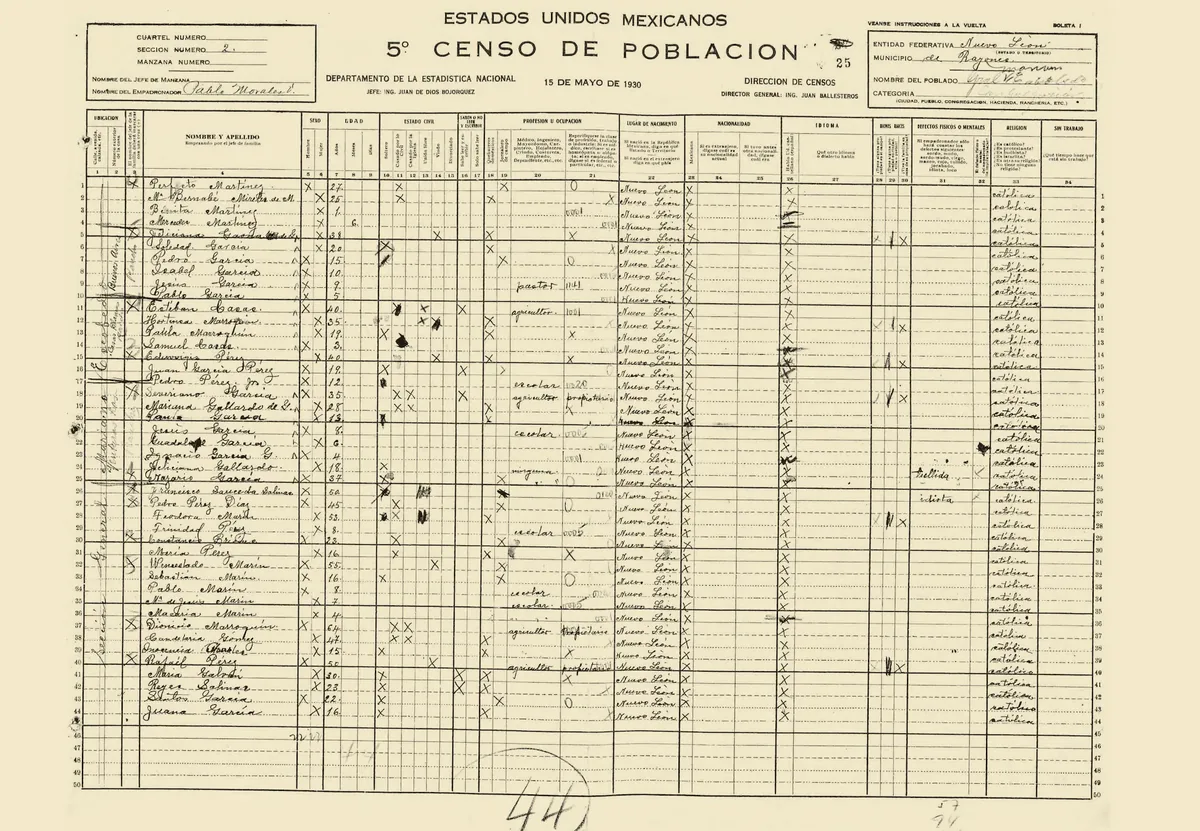
Anna Kowalczyk's page sat in a family tree for years with four facts pulled off it: name, age, birthplace, occupation. Chicago, 1920. Husband, four children, "presser" listed under her husband's name. Import just those four facts and you get a family. Read the rest of the page and you get a family that arrived on a specific ship, filed specific paperwork, and paid a specific price for the apartment they were renting that spring. Six more answers sat within two inches of her name. Her relationship to the head of household. The year she landed. Whether she'd started the naturalization process. Whether she could read. What the rent cost. Almost nobody copies those columns into a tree. They're the ones worth reading first.
Who's the head, and who's just living there.
Every US census from 1880 on records a relationship to the head of household, and that column is doing more work than "wife" or "son" suggests. On Anna's page, a niece is listed two lines below her children, sharing the family's last name but not their parents. Follow that one line and you find a sister who died young, leaving a daughter the Kowalczyks took in without anyone writing it down anywhere else. A "boarder" with a different surname living next door might be an actual relative who didn't want to be counted as one. A "mother-in-law" listed as head, with her married daughter recorded underneath her, tells you whose name was on the lease. Read the household as a unit before you read anything else on the page. It tells you who was supporting whom.
One roof doesn't mean one family.
The census counted dwellings and families, not a household in the sense most researchers assume today. Every schedule from 1880 through 1940 carries two separate numbers next to a person's name: a dwelling number and a family number, and the gap between them is where a lot of real households hide. Two family numbers under one dwelling number means two separate households sharing a building, most often a two-flat or a subdivided house, not one blended family with an odd assortment of surnames. One family number stretching across fifteen or sixteen names, on the other hand, can mean an adult son, his wife, and their children were all counted under his father's headship: three generations and two married couples reported as a single family unit, because that's whose name the enumerator wrote first. Reading a household as automatically nuclear, parents plus their own children and nothing else, makes both patterns look like anomalies. They aren't. Shared housing among relatives was the ordinary shape of working-class and immigrant life well into the twentieth century, driven by rent, not by anything unusual about the family. A researcher who assumes nuclear and stops there misses the daughter-in-law who was actually a second wife, the uncle who was really a boarder from the old country with no blood tie at all, or the two brothers whose families split one address for a decade before either could afford a place of his own.
The occupation column is carrying more than a job title.
Starting in 1910, the census split a person's work into occupation and industry, then added a third question: wage earner, employer, or working on your own account. Anna's husband is listed as "presser," industry "men's clothing factory," wage earner. That third answer matters. It means he didn't own the shop, and it tells you exactly which kind of business record to go looking for next: payroll ledgers and union rolls, not a business license. Watch that column change across census years for the same person. A laborer who becomes a foreman, or a peddler working on his own account who becomes a wage earner at a named company ten years later, is a mobility story no tree-building software surfaces by itself. You have to put two decades side by side to see it move.
Immigration and naturalization columns point to a real document.
From 1900 through 1930, the census asked foreign-born residents for their year of immigration and marked citizenship with a code: Al for alien, Pa for first papers filed, Na for naturalized. Starting in 1920, it asked for the year of naturalization outright. Anna's 1920 line reads "Na, 1917." That single code is a pointer. Somewhere in a federal or county court from around 1917 sits an actual naturalization petition, and that petition usually lists her exact town of birth, the one the census never asked for. A "Pa" that never becomes an "Na" ten years later is a smaller story worth noticing too: someone who started the process and, for reasons the record won't tell you, never finished it.
Literacy, rent, and the questions that only show up in later decades.
Every census from 1900 through 1930 asked whether a person could read and write, a plain yes or no for anyone over ten. Anna's column reads "no" next to her name and "yes" next to all four of her children's. That's the sharpest one-line summary you'll find anywhere of what her generation gave up so the next one wouldn't have to. The question disappears after 1930, replaced by a highest-grade-completed field, so tracking literacy across a family means stopping there. The 1930 census also asked whether the family owned or rented, what the home was worth or the rent cost, and whether the household owned a radio set. Anna's family rented, eighteen dollars a month. The 1940 census added a question about where each person lived five years earlier, plus income and schooling questions asked only of two people per page, marked with a circled name. That circle identifies the informant, the person actually standing in the doorway when the enumerator knocked, which matters more than it sounds like it should when an age or a birthplace looks off.
The circled name carried the real economic story.
Two names on every 1940 census page got a circle. That mark meant extra questions, the kind the rest of the page never asked. One of them recorded a usual occupation separate from whatever the person happened to be doing during the last week of March 1940, and the gap between those two answers is where the Depression shows up on paper. A man whose occupation that week reads "WPA laborer" but whose usual occupation reads "machinist" was not a laborer by trade, whatever the first column implies. He was a tradesman with no trade to work in, doing relief work because the shop that used to employ him had cut back or shut down. The circled name also reported income for all of 1939 in dollars, not a class-of-worker code standing in for one. It reported the highest grade of school completed too, replacing the plain literacy yes-or-no that disappeared after 1930 with something finer-grained: not just whether someone could read, but how far their schooling actually went. Put the income figure next to the usual-occupation answer and you get something no other census year hands you on its own: an actual wage next to an actual trade, for one specific year, with the schooling that got that person there sitting right beside both. For research built around who climbed and who didn't, those few extra answers outweigh the rest of the page. You just have to know to look for the circle.
A misspelled name or a shifted age is a clue, not a mistake to fix.
Anna is "Kowalczyk" in 1910, "Kowalczyk" again in 1920, and "Kowalski" by 1930, with an age that gains only three years across a decade that should have added ten. Don't smooth that into one clean answer on the way into a tree. Enumerators wrote down what they heard, often from a neighbor or a child answering the door in a language that wasn't their first, and consistency was never part of the job. Each spelling and each age is a separate data point about who was talking and in what language that day. Line the variants up side by side instead of averaging them away, and the drift itself starts pointing somewhere: toward the informant, the accent, sometimes toward the exact year a family decided their name would be easier to live with in English.
The map the enumerator carried, not the one you're using.
Every census from 1880 on was organized by enumeration district: a geographic slice small enough for one enumerator to cover on foot or by wagon in the weeks allotted, redrawn from scratch nearly every ten years as neighborhoods grew or emptied out. An ED boundary follows the streets and wards the Census Bureau drew that year, not the address on a birth certificate or a modern map. The two frequently disagree. Chicago renumbered its entire street address system in 1909. A family at one address in the 1900 census and what looks like a different address in 1920 may never have moved a single block; the street just counts differently now. Multiply that kind of change across every city that renumbered its addressing scheme and every rural district split apart when a new rail line brought in more settlers, and an ancestor who "disappears" between census years is very often sitting exactly where the family always said. He's just filed under a district that no longer maps cleanly to any address you'd type into a search box today. The fix is to find the district itself before hunting for the person. Steve Morse's One-Step census tools convert an old street address into the correct enumeration district for a given year, and once you have that number, browsing the actual page images beats trusting an index built by someone squinting at a name they'd never seen written down before.
That's the real gap between reading a census entry and reading a census page. The entry is four facts. The page is a household that might be two households, a legal status, a trade and a wage in the same year, an education, a rent payment, an informant, and a district that no longer matches any map you'd recognize today. Deep Research on AncestorIQ pulls the whole page into a person's file for exactly that reason, not just the name and age off it. The columns nobody transcribes are usually the ones with something to say.