Every family tree has one ancestor like this: birthplace listed as "Austria-Hungary." Or just "Russia." Or "Prussia," a country that stopped existing in 1871. Somewhere between the ship and the census taker, the actual town got lost.
Work backward from America, not forward from Europe.
The instinct is to start digging through European archives. Don't. The town name is almost always hiding in one of five US document types, and they rank in a rough order of payoff: naturalization papers, passenger manifests, draft registrations, US church records, and the Social Security SS-5 application. Once one of them names the town, European records open up fast. Before that, you're guessing at where a needle sits in a haystack the size of a country.
The manifest is only as good as the year on it.
A passenger manifest was nearly useless for finding a hometown for most of the era Americans think of as "the immigration years," and knowing exactly when that changed will save you weeks. The lists required under an 1819 federal law, the ones covering Castle Garden's run as New York's immigrant depot from 1855 to 1890 and the earliest years of Ellis Island after it opened in 1892, recorded almost nothing: a name, an age, a sex, an occupation, a nationality. No town. No last residence. No one back home. Step off a ship in 1885 and that manifest was never going to hand you a village, no matter how carefully you read it. Then it changed fast. A round of federal reforms starting in 1893 added a longer set of questions: marital status, last residence (an actual place, not just a country), final destination inside the United States, whether the passenger had been to America before, and whether they were joining a relative already here, complete with that relative's name and address. Race or people got added in 1903, which is how a manifest can list someone's nationality as Russian and their race as Hebrew on the same line: two different questions, two different answers. A full physical description arrived in 1906: height, complexion, hair and eye color, marks. Then in 1907 came the field that matters most for this kind of search: the name and address of the nearest relative left behind in the old country, not the one being joined in America. When that column survives legibly, it can name a living person still standing in the exact village you're trying to identify. So check the arrival year before you decide what a manifest owes you. An 1888 arrival needs a different plan; go to naturalization papers or a church record first. A 1910 arrival might already have the village sitting in a column, plus someone who was still living there when the ship left port.
The Austria-Hungary that wasn't Croatia.
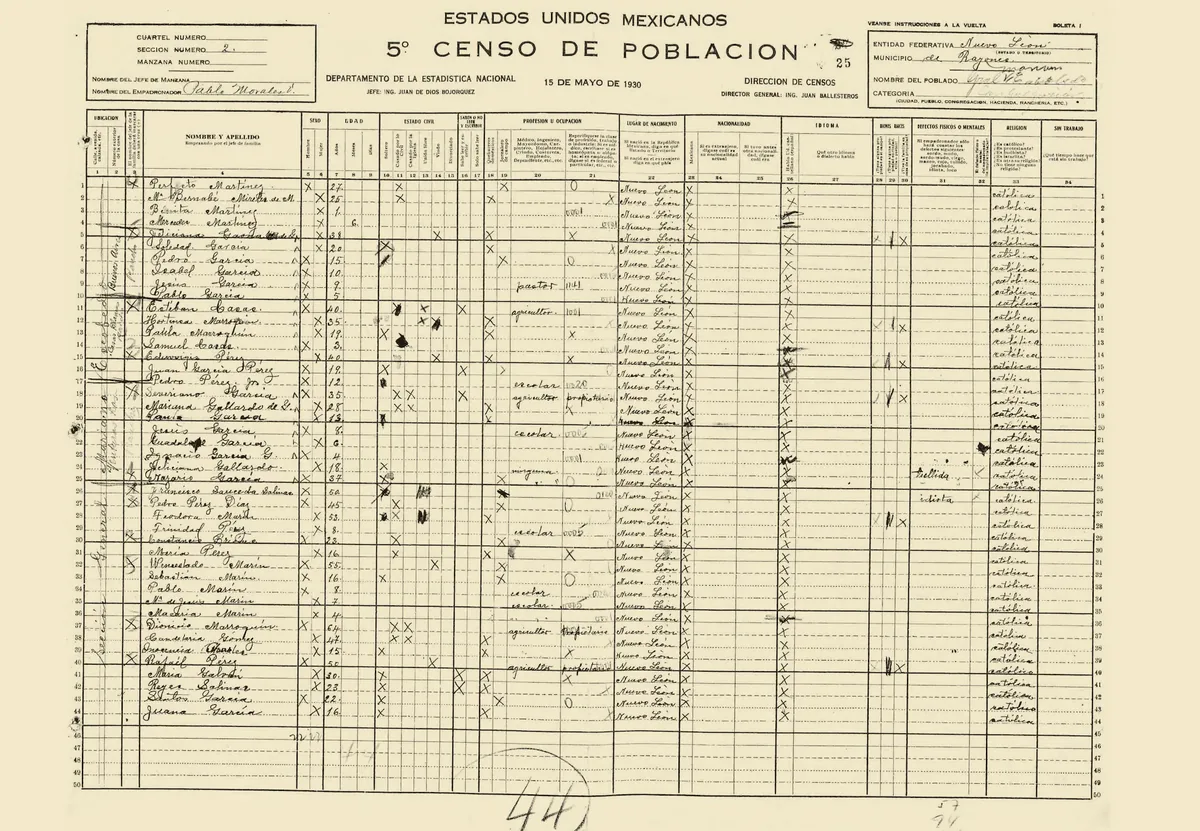
One researcher had a great-grandfather listed only as born in "Austria-Hungary" in 1888, and Zagreb's archives had turned up nothing. Three US records cracked it: his WWI draft card (June 1917 asked for an exact town of birth), his 1942 "old man's draft" registration, and his SS-5 application, which lists a birth town plus both parents' names for about thirty dollars from the Social Security Administration. The real clue, though, was one word on the 1930 census: it listed his birth country as Czechoslovakia, which didn't exist before 1918. That redirected the whole search toward Slovakia or Moravia instead of Croatia, and explained exactly why Zagreb never had a record to find.
Working backward from the port when only the year survives.
Sometimes all you know is a year: no ship name, no exact date, and a surname common enough that an index search buries the real entry under a hundred wrong ones. Work backward from the port instead of guessing at a date. The Morton Allan Directory of European Passenger Steamship Arrivals lists, ship by ship, every vessel and its arrival date at the Port of New York from 1890 to 1930, and at Philadelphia, Boston, and Baltimore from 1904 to 1926. Cross that against the departure port a family story mentions (Hamburg, Bremen, Rotterdam, Liverpool, Trieste, Fiume) and an approximate month, and a decade to search blind turns into a short list of candidate sailings. Stephen Morse's One-Step search forms, hosted at stevemorse.org, are worth bookmarking too. They layer more flexible search fields on top of the Ellis Island and Ancestry indexes themselves, which helps when a name is misspelled too badly for either site's own search box to find it. Once you have candidates, a shipping line's own records sometimes outlast the manifests built from them. Hamburg kept outbound passenger registers, the Auswandererlisten, starting in 1850, and the surviving volumes are held at the Staatsarchiv Hamburg and searchable today. Bremen's equivalent is almost entirely gone, destroyed to save storage space rather than preserved, which is exactly why the Prussian case below has to work from a permission file instead of a departure list. The rule holds regardless of port: when a name search fails, stop searching for the person and start searching for the sailing. A ship existed on a specific date whether or not an index caught the passenger's name correctly, and working from that direction turns an impossible search into a handful of manifests worth opening by hand.
When the departure lists were destroyed.
An 1854 Prussian emigration is a harder case. Bremen's departure lists were destroyed outright, and Hamburg's surviving lists don't get genuinely useful until after 1855. The fix is to flip sides. Prussian emigrants from Westphalia and the Rhineland needed government permission to leave, and those Auswanderung applications, which list a home village and family members, survive in state archives in Münster, Detmold, and Düsseldorf. Pair that with the family's German Catholic or Lutheran parish in America (1850s marriage and burial entries routinely name the exact home village), and a ship's manifest that just says "Prussia" stops being the end of the trail.
Sweden's parish books outdo any American record for this one job.
A Swedish case runs the opposite problem: not too little information, but a surname so common it's useless on its own. Family history says a great-great-grandmother left "Sweden" around 1888, no parish named, and Andersson is one of the most common surnames in the country. A name-only search across records this crowded returns thousands of candidates and confirms none of them. The record that breaks this case isn't American at all. It's the husförhörslängd, the household examination book every Swedish Lutheran parish clergy have been required to keep since 1686. Unlike a single-moment census, a household examination entry follows one person continuously on a running page: birth, confirmation, literacy results, military service, and the exact parish a family moved to when they left, updated year over year instead of recorded once. A flyttningsbetyg, the moving certificate a parish priest issued to anyone relocating (mandatory since 1812), often names the destination parish outright, sometimes down to the receiving congregation in America. Sweden's National Archives, Riksarkivet, has digitized nearly the whole national set and put it online free through its Digital Research Room. The catch is the one that trips up every first-time researcher here too: these books are organized by parish, not by a national name index, so you still need a parish before you can open the right volume. A moving certificate, an emigration record from the departure parish, or an American Swedish Lutheran congregation's own register naming the old-country parish is usually the fastest way to get that name in hand. The Swedish Emigrant Institute in Växjö, working with Swedish genealogical societies, also maintains an index of over 1.1 million emigrants, roughly three-quarters of everyone who left the country between 1845 and 1930, worth checking when a household record itself has gaps. Once you have the parish, a household examination page traces a family across boundaries in a way no single American record was ever built to do.
Why the town's religion matters as much as its name.
For an 1892 Hungarian birth, there's a hard date worth knowing: Hungarian state civil registration didn't start until October 1, 1895. Anything earlier was recorded by the church, not the government, which means you need two facts instead of one: the town, and the family's religion. Catholic, Reformed, Lutheran, Greek Catholic, and Jewish congregations each kept separate registers. FamilySearch has filmed a large share of pre-1895 Hungarian church books, but they're browsable by locality in the catalog only, not searchable by name. And "Hungary" in 1892 covered modern Slovakia and Transylvania too, so the actual village may sit across a border that didn't exist yet.
The wrong turns almost everyone makes.
Two mistakes account for most of the dead ends in this kind of research. The first is treating the nationality written on an American record as if it maps cleanly onto a modern country. Before 1918, "Austria," "Hungary," "Russia," "Germany," and "Turkey" were political labels covering dozens of ethnic homelands and thousands of villages that now sit inside different countries entirely, which is exactly what tripped up the Zagreb search above. It cuts the other way too: a clerk sometimes recorded the language a person spoke rather than the empire on their passport, so "Polish" on an 1890 document can mean a village in the Russian, German, or Austro-Hungarian partition of a country that didn't exist as a state again until 1918. The label is a starting clue, not a conclusion. Confirm it against a second record before you plan a search around it. The second mistake is trusting family legend about which country an ancestor came from without checking a document first. Family stories compress across three or four generations in predictable ways: the actual town drops out and only the empire or a nearby well-known city survives ("near Kraków," "outside Naples"), a region gets swapped for a country once a border moved, or the wrong country gets substituted because it's the one everyone else on the block came from. Galicia is the case genealogists run into constantly: a family insists they're "Russian" because the whole neighborhood was, when the actual manifest says Galicia, a province of Austria-Hungary at the time and now split between Poland and Ukraine. Two countries removed from what everyone always said. Treat the family story as a lead worth checking, not a fact worth building on. A document beats a memory whenever one is available, and it usually is.
Once you have the town.
This is where the method pays off. A named town unlocks European church books and civil registers, and most of what survives for Western and Central Europe is already filmed on FamilySearch for free. The hard part was never reading a foreign parish register. It was knowing which village to ask for. AncestorIQ's Deep Research is built for exactly that next step: hand it a name and an approximate year, and it works across FamilySearch and other historical archives at once, instead of you opening one parish microfilm after another by hand.